



Winner
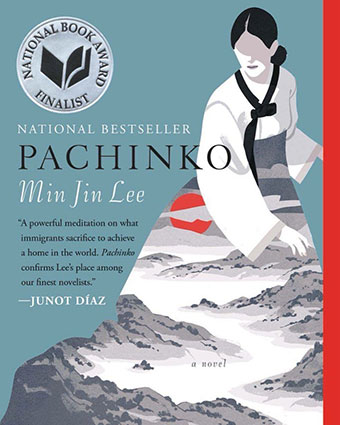
Pachinko (2017)
As Korea suffers under Japanese colonial rule, Yangjin, hailing from Yeongdo in Busan, marries Hoonie, cripple and harelip, for money due to her family’s poor economic situation. Sunja, their daughter, moves to Japan where she gives birth to two sons, and those sons go on to grow up and have their own sons in Japan. This book details the sad reality of ‘Zainichi’ Koreans, who drift as outsiders, neither fully Japanese nor Korean, and suffer endless discrimination from mainstream Japanese society.

Min Jin Lee
Min Jin Lee‘s Pachinko was a finalist for the National Book Award. A New York Times Bestseller, Pachinko was also a Top 10 Books of the Year for New York Times, USA Today, BBC, and the New York Public Library. Pachinko was on over 75 best-of-the-years lists, including NPR, PBS, and CNN. Lee’s debut novel, Free Food for Millionaires (2007), was a Top 10 Books of the Year for The Times, NPR’s Fresh Air, and USA Today. Her fiction has been featured on NPR’s Selected Shorts and has appeared most recently in One Story. Her writings about books, travel, global affairs, and food have appreared in The New York Times Magazine, The New York Times Book Review, The Times Literary Supplement, Conde Nast Traveler, The Times of London, Vogue (US), Travel + Leisure (SEA) and Wall Street Journal. She has served as a columnist of the Chosun Ilbo, South Korea’s leading newspaper, for three seasons. She has recived the NYFA fellowship for fiction, the Peden Prize from the Missouri Review for Best Story, and the Narrative Prize for New and Emerging Writers. A 2018 recipient of a Guggenheim Fellowships for fiction, Lee has been named a fellow at the Radcliffe Institute for Advanced Studies at Harvard University for 2018-2019, where she will be researching and writing her third novel, American Hagwon.
* Photography by Beowulf Sheehan

Seung-Mi SHIN
Seungmi Shin is a graduate of Chosun University, where she majored in Korean Language and Literature. She was a professional journalist with six years of experience in writing and editing articles for magazines before she started working as a translator. She has translated about 50 books over 16 years. Her work includes Simple Abundance, The Book of Eels, Hello I Want to Die Please Fix Me, Beneath A Scarlet Sky, To Complete A To Z For Your V, What if My Dog...?, Not Without My Father, Madly in Love with Me, Squeezed : What You Don't Know About Orange Juice, The Velveteen Principles for Women, The Book of Luck, The Blue Zones, Unbroken, Dr. Suzanne Steinbaum's Heart book, Home Sweet Anywhere.

Mi-Jung LEE
Mi-Jung Lee is a translator and a graduate of English Literature at Yeungnam University. Her translations include Lost Apothecary by Sara Penner, How to do the Work by Nicole LePera, Last Day by Luanne Rice, Brave Not Perfect by Reshma Saujani, The Adventures of Tom Sawyer by Mark Twain and The Curious Case of Benjamin Button by F. Scott Fitzgerald.
Pachinko by Min Jin Lee is a story of life and survival, desperation, and tenacity. It lets its readers relive family history of “Zainichi”, or Koreans residing in Japan, across four generations through its intricate and acute depiction of the lives lived. The survival stories of characters represent hardships of Chosun, the characters’ mother country, which had endured foreign invasions one after another in the late 19th century on one hand. On the other, it represents diaspora of any unfortunate traveler wandering around foreign soil under unavoidable circumstances.
Pachinko illustrates human’s will and ability to source means to persistently survive against everyday struggles. Readers are enthralled by the ferocious and unpredictable hostilities that is life itself, and drawn to applaud the vitality of human facing them. Lee presents colorful variations of human battle against their fate bringing the narrative truer to the reality.
Pachinko brings to the readers more than depiction of survival story. Throughout the book Lee has the readers question what makes us human. We are reminded that human has to themselves to prove their worth and dignity. Survival loses meaning when achieved by making lies or excuses, or by chance. Life has a meaning when one becomes an existence worthy of life. With dignity and integrity as core themes behind the narrative, Pachinko gracefully inspires the readers to make a firm determination at living with dignity, or to climb the steep stairs of the human mind. This alone would be sufficient ground to entitle the book a classic.